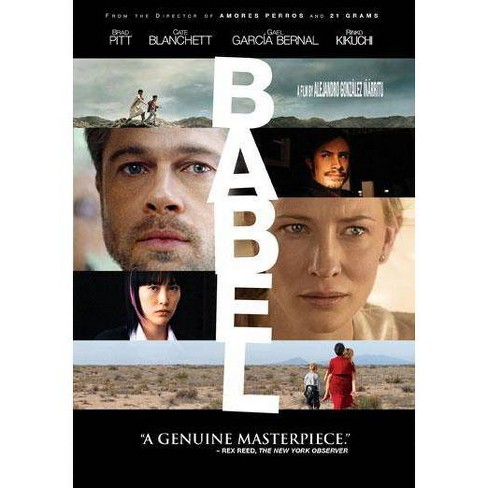
Up until being assigned to watch Babel for the purpose of this course, I had neither seen nor even heard of this film. This was surprising to me since the two American stars of the film, Cate Blanchett and Brad Pitt, are so consistently prevalent in the face of modern Hollywood. It’s rare when a movie they come out with doesn’t initiate an extensive amount of “in-your-face” marketing. However, after watching the film for myself, and doing some research on the film’s release, I can now see why it had escaped my attention.
The film was only first released in seven theaters around the world, so of course the opening night wouldn’t have attracted as much attention as a film simultaneously released in theaters all over the world. Nearly a week later, the film expanded into 35 theaters, and hit just over 1,200 theaters in the week to follow. As such, it doesn’t seem like this film would have been in the topic of conversation. Since the film observes complex topics related to miscommunication, racial biases, loss, and the ripple effect of a person’s actions, I can see why this film was only marginally observed by critics.
After watching this film, I felt a deep sense of unease. The American film industry has taught me to seek resolution, to find a happy ending in even the darkest of stories, and Babel upsets this expectation. It refuses to give the audience a positive resolution, just as it refuses to make the audience feel comforted by any promise of a better outcome for any of the characters.
I think this feeling of unease is intentional. I think the makers of this film wanted to share a story that doesn’t fit into the norms of a regular tale. At the heart of it, I think this story is a story related to the idea of the butterfly effect. There is this idea that the event of something in one place can have ripple effects that affect the happenings of events in another. In this case, we see how the actions of two young boys in Morocco can inadvertently affect the deportation of a Mexican woman. The people involved never have any direct contact with one another, yet the actions of one can most certainly affect the other.
As I struggled to make meaning of this film, I turned to the voices of academic scholars who have analyzed this film through their educated perspectives. As suggested by our teacher, I came across an analysis written by Todd McGowan titled “The Contingency of Connection: The Path to Politicization in ‘Babel.'” In this article he writes about the film’s use of events, and how they are carefully structured to ignite a more political message than a spiritual one. He writes, “Films like Babel… undermine the ideological idea of self-determination and control over one’s destiny. But subverting the idea of individual agency often goes hand in hand with locating agency in a hidden force, lurking behind nominal authority figures, that pulls all the strings, and this is what Babel avoids. There is no hidden God…” (McGowan 7)
Through his analysis, McGowan shows how a film like Babel can be seen as a politicization, which encourages the viewer to think deeply about current political issues and related concerns. He then goes into the topic of the “Other” and presents this concept as a theme ever-present in the film’s story. In his analysis, the “Other” represents the unknown, or the way it is unknown how one person’s actions can affect another’s.
When looking at the film this way, I can gain an even further understanding into why it wasn’t the hot topic of conversation when it was released. Modern (American) audience members don’t want to watch a story that’s political, a story that challenges their worldview, or suggests that their actions will have unintended consequences. In this way, I think this makes the film even more poignant and politicized, in that it encourages those who do watch, to find their own message to take away. Not only a message to take away, but a message that one can act upon for themselves in the way they view their own actions and question how it might affect the lives of others.
 Melissa Voita - JMC 309
Hey Melissa,
I was also surprised that I had never heard of this movie with two very famous actors in it and winning the golden globe. I found it really interesting reading the history of the releases of the movie and it makes more sense now why we haven’t heard of it. It very interesting that all the movies today ether have a happy ending or a conclusion but this one leave you with a deep sense of unease just like you said. I felt the same way.
LikeLiked by 1 person
Melissa,
I found your analysis interesting. I also used the same article in my critique. The out of sequence shots were good at keeping my attention. So many movies and TV shows now days are easy to predict and I find myself not paying attention. I look forward to your future posts.
LikeLiked by 1 person
Thanks, Melissa, for your careful attention to the movie and to some of the academic thought about the movie. I think there’s a bit of a disconnect because the movie’s now 14ish years old. It didn’t kill at the box office, as you note, but it was well received and lauded by critics. Nominated for seven Academy Awards and won one. Won the Golden Globe for best picture in 2007. “Babel” was all the rage — about five years after the events of Sept. 11, 2001, shook our nation. When our sons were starting to come back injured from Iraq and Afghanistan, or not come back. It was a movie for those times. As you describe so aptly, the movie generates a sense of “unease” that’s atypical for the feel-good Hollywood blockbuster, for sure.
I’m so glad that you dug into the McGowan reading about the “Other.” The movie provided so many moments to step into the experience of the Other. That makes the political personal, as you write, it “encourages the viewer to think deeply about current political issues and related concerns.”
Thanks for your work to view and understand the film at a higher level. Exemplary post here!
LikeLike