In today’s meat industry, consumption is happening at a much faster rate than production. To meet this need, people are turning to science, in the hope the genetically modified meats can serve as a “solution” to meet the needs of meat consumption. In the controversy surrounding genetically modified meats, those in favor of the practice tend to sell it as a “more ethical” and “sustainable” approach (see this article).
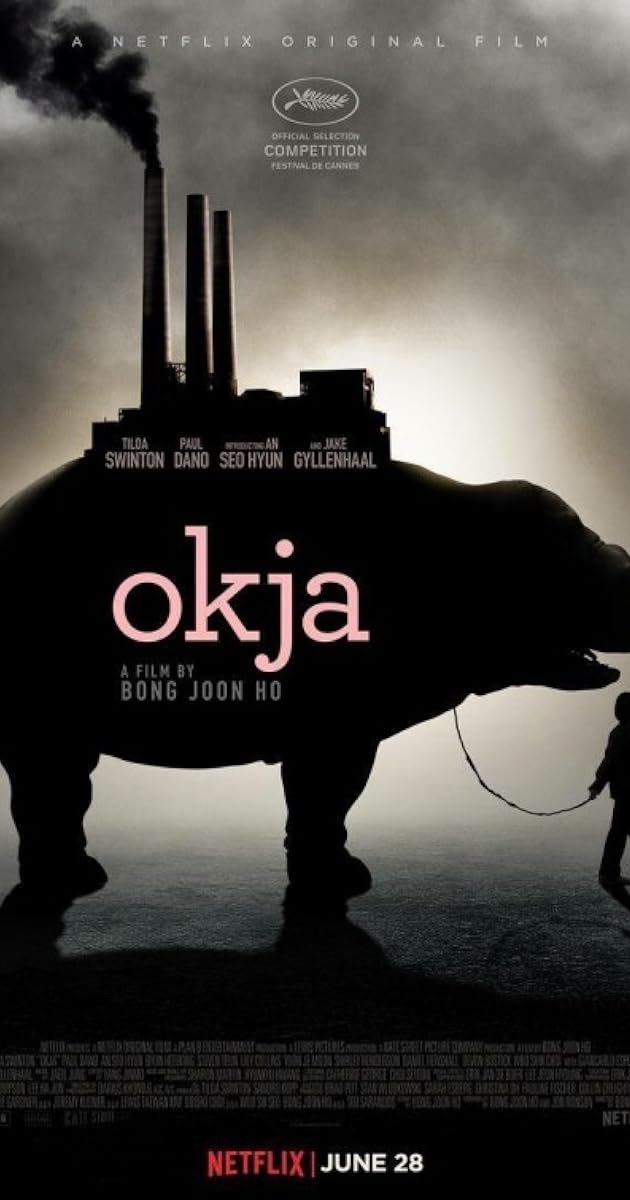
However, the movie Okja presents a more realistic take on the repercussions of genetically modified animals, by reminding us that even genetically engineered animals still have feelings AND the meat processing industry still operates with inhumane practices.
The film begins with an introduction into Mirando Corp, a business that historically fits into the worst kinds of capitalism. Only now, Mirando Corp is being rebranded by the daughter of the company’s owner, Lucy. She tries to reframe Mirando Corp as a company of the future. In a great marketing platform, Lucy gifts 26 genetically modified “super pigs” to farmers all over the world, where they will be raised for the next ten years, and eventually, a winner will be chosen. To the audience, this plan seems like a brilliant ploy to normalize genetically modified meat into American culture, so that, in the next ten years, they can move on with the production of genetically modified meats without so much as a hiccup.
The film then flashes forward and jumps across the world to ten years later in Korea, where we meet Mija and one of the 26 super pigs, Okja. Up until this point in the film, the viewer has only been exposed to the grey factory image of corporate capitalism. It isn’t until we meet Mija and Okja that the viewer sees a more natural side. Ecocriticism encourages the viewer to look into the ways nature is presented within a film. In Okja, the only nature we are really exposed to is in the homeland of Mija and Okja, which is in Korea. When the Mirando Corp people come to visit their farm, we learn that it is difficult to get to. In this way, the nature of this film is presented as inaccessible to all, peaceful, and devoid of any corporate/ big city living.
When Mirando Corp comes to take Okja away as the winner for their super pig contest, Mija is overcome with anger. She did not expect to have Okja taken away, as her grandfather did not inform her of this until it was too late. For the remainder of the film, Mija’s mission is to return Okja back home to their farm in the mountains, but this is sadly not achieved without some terrible obstacles.
In an interview about the film, director Bong Joon-ho mentions, “Films either show animals as soulmates or else we see them in documentaries being butchered. I wanted to merge those worlds. The division makes us comfortable but the reality is that they are the same animal.” It is this discomfort that the film seems to be trying to invoke in the viewer. Through the story of Okja, the viewer realizes that even genetically modified animals still have feelings and the ability to form attachments with humans.
The film seems to be reminding viewers of their own involvement in the meat industry– it doesn’t just start and end with the packaged meat we buy in the grocery store. Instead, the film encourages the viewer to step outside of their mindless consumption and begin to question: where is it coming from? How is it being made? And most importantly, is it being made ethically? These are some of the many questions that animal activists, such as the Animal Liberation Front (ALF), have been trying to get people to ask for many years. Okja takes all of these issues outside of the PETA pamphlet and aims to make them more real for the audience through the heart-wrenching friendship of Mija and Okja. In this way, the film can be seen as a criticism of not only the consumption of meat in America, but also a criticism of our humanity.
 Melissa Voita - JMC 309
Hello Melissa,
Awesome post! I really appreciate your look at the relationship between humanity and the treatment of animals. We are very removed from this process as a nation. Most people have probably heard about the maltreatment of animals being produced for meat but continue to buy the conveniently packaged meat from the store without much thought as to where it came from or how it was treated. This film was an excellent comment on the meat industry that is so focused on profit vs. humanly treating animals. Once again great post!
LikeLike
Hi Melissa! I really appreciate your post and I find your thoughts to be super clear and interesting. I’m glad you added the interview from the director of Okja because he makes a good point. We are often shown animals in either two ways: our loving pets or being butchered. I agree with your point that “it doesn’t just start and end with the packaged meat we buy in the grocery store.” In many ways, I feel like being informed on meat production is a choice. We have access to learning about these processes, yet at times we choose to just buy the cheap, packaged meat and think no further!
LikeLiked by 1 person
Hey Melissa,
Thanks for putting that link in your post and explaining why this movie was created. It is frustrating that the meat corp. are marketing their food as more “ethical” and “sustainable”. If you don’t understand GMO you could easy be pushed into this trap set with good marketing. I think you really got the main point of this film “viewers realizes that even genetically modified animals still have feelings and the ability to form attachments with humans”. It’s trying to show us that even meat animals have feelings and should be considered and respected. Sometimes i think people have more connections with animals in films than they do for with the actors.
LikeLiked by 1 person
Thanks Melissa, I followed the link and read more info. I also liked your concluding paragraph about our meat consumption and our humanity.
LikeLiked by 1 person
Hi Melissa!
I thought that you gave a really good description of the film, and some of the key points of the film. I really like how you included a quote from the director of the film about making the film uncomfortable in order to get the meaning across to the audience. I have to agree that after watching the film I looked at how I was contributing to the meat industry, as you stated the film intended. Overall great post.
LikeLiked by 1 person