For those who have seen James Cameron’s Avatar, it becomes hard to deny that the film offers an ecological perspective with an environmental message. The Na’vi, the native people of the planet Pandora, are portrayed as enlightened individuals, interconnected with the synchronicities of nature. In contrast, the humans from Earth are portrayed as profit-hungry conquistadors, reliant on the brute power of technology. However, the human race is offered some repent, through the “tragic hero” Jake Sully and his trustworthy comrades.

In a chapter titled “Waking Up From Avatar,” Professor Deidre Pike analyzes the character of Jake Sully. She describes him in a way akin to Aristotle’s perspective, as a man of “high moral order,” who has been slighted by the world around him through his fair share of tragedies. In this way, he is unlike the power-hungry conquistadors: not motivated by power, but motivated by a desire to be like everyone else (to walk again). It isn’t until his connection builds with the Neytiri and Na’vi when he realizes, that being like “everyone else” means subscribing to the moral good and being one with the nature around you.

From an Ecofeminist perspective, the film opens itself into rarely charted territory. A modern feminist might find a sense of pride and power in the way that the women of the Na’vi are portrayed. Gender roles don’t seem to follow the path of the patriarchy in Na’vi culture. In fact, Neytiri fights, flies, and defends alongside the men of her tribe, as do many other females in their culture. She acts as a guide into the realm of Pandora for Jake, and it is her who seemingly holds the upper hand of knowledge. Additionally, her mother is a very important member of the tribe, as she is respected for her shamanistic-like visions and perspective. The female human characters of the film are portrayed as mildly admirable as well. Grace is an established scientist, and Trudy, well she represents your stereotypical bad ass bitch, guns and boobs out for all. I’m not saying these characters are perfect in the eyes of feminism, but they do seem to represent a characterization of woman we aren’t used to seeing in films about capitalist colonization.
The above perspective leans more toward a typical feminist interpretation, which of course would require even more digging for meaning; however, an Ecofeminist perspective would look at the film from an even different angle. In a chapter titled “Ecofeminist Literacy Criticism,” writer Gretchen T. Legler discusses the common representation of nature as feminine. In English culture, we have the common perception of “Mother Nature,” and many other cultures across history have given feminine quality to nature’s attributes.
Something very interesting in Avatar is that the Na’vi people also make nature feminine. The deity, “Eywa,” which they believe controls the various synapses between nature’s interconnectedness on Pandora, is referred to by the Na’vi as “she.” As mentioned, the shaman-like individual within their culture, who channels the energy of of Eywa is also a female. I think this relates to Biblical perceptions of nature and the feminine. Eve (before she commits sin) is portrayed as pure, untouched, and with great potential for knowledge. Likewise, nature is often portrayed as such. The nature in Pandora is worshiped for it’s beauty, much like women in human culture are worshiped for theirs.
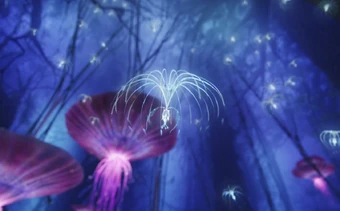
This perception of the feminine as it applies to nature in Pandora opens a figurative Pandora’s box into the many interpretations and potential criticisms that can be made. But, for the sake of brevity, I will leave the post here and ask for your thoughts instead. What message do you think Cameron tries to portray in the way that the feminine is portrayed in the film? What links between the representations of the female characters in the story can be made to the link of the feminine identity represented in the nature of the film? Leave your thoughts in the comments below, I look forward to reading them. 🙂
 Melissa Voita - JMC 309
Melissa,
I think Cameron tries to portray females in the film as equals to their male counterparts, which for the most part he is successful in yet ultimately with a male main character and two male villains the achievement of balance is forever out of reach. I think the movie made an effort to try and balance the gender issue further in the casting of Sigourney Weaver, who in the Alien movie franchise is a lead female hero. I find it possible that the loss of a connection to nature in modern society, is what links the representations of the female characters in the story to the link of the feminine identity represented by nature of the film. Sigourney’s character seems to desire the connection with nature held by the Navi however, her approach is kind of backward through the institutional education she brings to the Navi. This confusion on her part is probably like you say due to the fact that “Grace is an establishment scientist, her want for a connection with nature is overruled by her social arrogance and the belief that she is somehow bringing advancement or improvement to the Navi people. Anyways, great post and thanks for your comment on mine.
Ash
LikeLike
You’ve done an exemplary job of putting together a reading of the film with the ideas of ecofeminism. And you even worked in some of my thoughts on the central male character. I wrote that chapter about the time the movie came out, while I was finishing my dissertation. I watch “Avatar” in the movie theater several times, including once in 3-D, swimming in all that plant life. After several viewings, I’d decided that Cameron taps into the collective psyche on every possible level. He presents strong women characters — and a disabled guy. But in the end, it’s a capable dude with militaristic training who ultimately saves the day, the tribe, mother nature/Ewya and all of that.
Your discussion of the Eve character from the Judeo-Christian creation story make for another interesting parallel to the feminine and beautiful world of Pandora.
Much thanks for your post~
Deidre
LikeLike
Hello Melissa,
I also can agree that there are tremendous ecological messages in this film. One would think that humans would be more interested in the Na’vi than unobtainium because of how incredible their abilities are. The never explained in the film what unobtainium is actually used for. Luckily for the spirit tree seed landing on the arrow being aimed to kill Jake, otherwise things would have ended differently. Maybe the seeds have abilities to look into the future. The women in the film do play a more leadership role than other films, such as Disney’s Mulan, where women are not allowed to ‘fight’ in battle. I really like Trudy, and her character in her another blockbuster movie series.
I feel that Cameron feels very strongly about women and he may feel that they deserve more credit than they get. I also feel that this is how humans should act. Men are not the dominant sex and should have no dominant role over women, therefore enabling them to feel weak and powerless. Avatar shows that we can be equal and we all possess more strengths than others can see. I’m a little lost on your second question, but I know there is a strong link.
LikeLike